When Boston met Glasgow

Football might have brought Scotland to Boston, but it wasn’t long before the city realised this was about much more than what happened on the pitch.
As tens of thousands of supporters crossed the Atlantic for Scotland’s long-awaited return to the FIFA World Cup after nearly 30 years, Boston found itself swept up in an atmosphere unlike anything it had experienced before. Streets filled with kilts and Saltires, pubs echoed with songs that lasted long into the evening, and curious locals quickly became part of the celebrations. It wasn’t simply that Glasgow had arrived in Boston. Before long, Boston had joined the party.
Looking back, it’s hard to pinpoint the exact moment the relationship changed. Perhaps it was when Fenway Park became the backdrop to one of the tournament’s most memorable nights. Maybe it was the traffic cones appearing on statues across the city. It could even have been the tongue-in-cheek announcement that haggis had finally become legal in Massachusetts. Whatever the moment, one thing became increasingly clear. Boston wasn’t just hosting Scotland. It was falling in love with Scotland, and specifically, Glasgow.
A city with a sense of humour
If there’s one thing Glasgow has never been short of, it’s personality.
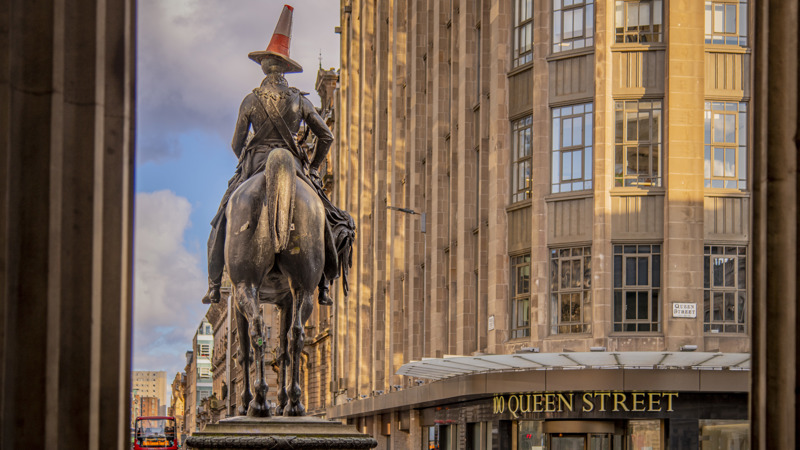
Our city has always had a knack for finding humour in the everyday, and nowhere sums that up better than the Duke of Wellington statue outside the Gallery of Modern Art. For decades, the famous statue has worn an orange traffic cone, transforming what began as a late-night prank into one of Glasgow’s best-known landmarks and an instantly recognisable symbol of the city’s playful character.
So perhaps it shouldn’t have come as too much of a surprise when Boston’s statues began sporting traffic cones of their own.
At first, it prompted puzzled looks from passers-by. Before long, it prompted conversations. Locals wanted to know the story behind the cones, while supporters were only too happy to explain one of Glasgow’s favourite traditions. Soon enough, traffic cone hats became almost as common as football scarves, with visitors and Bostonians happily posing for photographs together.
It was funny, unexpected and unmistakably Glaswegian.

More than a football crowd
What made Boston so special wasn’t simply the number of Scotland supporters who travelled there. Cities all over the world welcome major sporting events every year. It was the way people connected.
Supporters filled Boston Harbour with boat parties, marched through the streets behind pipers and turned ordinary afternoons into unforgettable memories. Friends who hadn’t seen one another for years unexpectedly reunited while queueing for a drink, while one supporter completed a remarkable 3,000-mile walk across America to reach Boston in time for Scotland’s opening match.
The stories kept coming.
A police officer delighted supporters by showing off his keepy-uppies in the fan zone. Residents woke to the sound of bagpipes drifting through their neighbourhoods before breakfast. Social media filled with feel-good videos watched by millions across the world, and even a playful joke about haggis being declared legal in Massachusetts briefly fooled delighted Scots on both sides of the Atlantic.
Behind every viral moment was something much simpler. People enjoying each other’s company, sharing a laugh and discovering they had far more in common than they might ever have expected.
Fenway Park discovers the Tartan Army
Even if you’ve never watched a game of baseball, you’ll probably know the name Fenway Park.
Few sporting venues carry quite the same sense of history, which made what happened there all the more remarkable.
As thousands of Scotland supporters made their way to the famous old ballpark for a baseball game behind the sound of bagpipes, Boston found itself witnessing something entirely new. Songs rang out around the stands, Scottish flags filled the stadium and baseball supporters embraced the carnival atmosphere with exactly the same enthusiasm as their visitors.
Later, the Boston Red Sox reflected that they knew Scotland fans were coming but hadn’t fully appreciated the warmth, colour and energy they would bring. It wasn’t simply another fixture in Fenway’s long history. It became one of those rare sporting occasions that people would still be talking about long after the crowd had gone home.

When Boston joined in
Perhaps the biggest surprise of all was just how enthusiastically Boston embraced every bit of it.
Businesses welcomed supporters with open arms. Bars did their best to keep up with demand, even if supplies occasionally struggled to keep pace. Police officers posed for photographs, local residents joined in the singing, and before long the city’s political leaders were enjoying the occasion just as much as everyone else.
Mayor Michelle Wu spoke about plans, alongside Lord Provost of Glasgow Dr Cllr Jacqueline MacLaren, to strengthen ties between Boston and Glasgow through a new twin-city partnership, recognising the shared opportunities the two cities could build together in tourism, culture, education and innovation.
Then came perhaps the most heartfelt moment of all.
After the tournament had moved on, Massachusetts Governor Maura Healey recorded a message for Scotland saying just how much Boston missed the visitors. She joked that the city even missed waking up to find traffic cones balanced on statues and promised that next time there would be plenty of beer waiting.
When one of America’s most historic cities is asking you to come back, you know you’ve left quite an impression.

A friendship that lasts beyond the football
The World Cup eventually moved on, as great sporting occasions always do.
The songs became quieter, the streets returned to normal and supporters continued their journeys.
What remained was something no fixture list could have predicted.
Boston’s newspapers wrote heartfelt tributes thanking Scotland supporters for the joy they had brought to the city. Friendships formed over a few unforgettable days continued long after everyone had returned home, while the proposed twin-city partnership between Boston and Glasgow offered the chance to build on a relationship that had begun in the most unexpected of circumstances.
It turns out that football was only ever the introduction.
The real story was about people.
Come and experience Glasgow for yourself
The best thing about Glasgow has never been something you can photograph.
It’s the welcome waiting behind the front door of a neighbourhood pub. The conversation that starts while you’re asking for directions. The live music you stumble across by accident. The humour that appears when you least expect it and the feeling that, even if it’s your first visit, you’re somehow already among friends.
A city with a big heart, a quick wit and an open invitation to anyone who wants to experience it for themselves.
If one unforgettable World Cup summer proved anything, it’s that the very best friendships often begin when you least expect them.